
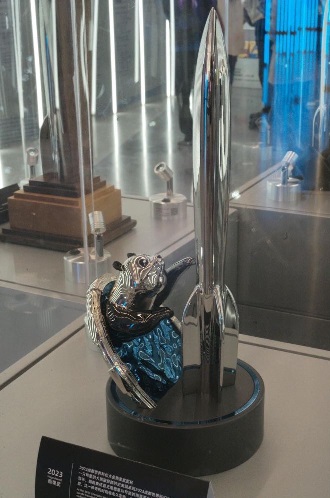
Awards are what they are. Does winning an award from a literary society make a book the objectively best of a certain category written that year? Setting aside that determining “best” when it comes to something as subjective as books is a little silly, I think we can all agree that it takes a certain amount of baseline popularity to even be considered. Hypothtically, the “best” book could be an indie title buried in a sea of algorithmic obscurity.
However…
That aside, these awards mean a great deal to readers and authors alike. They are a signal of quality. I’ve never read a Hugo, Nebula, or Locus-winning book that wasn’t highly entertaining and excellently crafted. Winning one of these awards can absolutely make your career. So, it should come as no surprise that there has been a strong backlash over the past two weeks when the Hugo nominee stats for 2023’s WorldCon, held in Chengdu, China in October 2023, revealed that certain popular nominated titles were arbitrarily disqualified. No explanation in the text. None from the Hugos. None from the event organizing committee.
How does something like this happen?
What Happened?
The Hugos are run by the World Science Fiction Society. Membership is open to anyone who pays $60 per year. Like a super democratic Olympic committee, these members vote two years in advance for the city which will host Worldcon, the convention where the Hugos are awarded. In 2021, this honor went to Chengdu for the 2023 convention, the first time China would host the prize. Here’s where things get odd. The WSFS does not techincally directly administer the Hugos. They run the vote for the host city and compose the nominating/voting body, but each year the details of how voting works and the logistics of the ceremony are left up to the local committee which runs the actual award ceremony. So, once the city was chosen, the 2023 Hugo awards were entirely in the hands of an event coordinating committee in Chengdu, China.
This relay-race approach is very different from the mechanics of other proiment speculative fiction awards, namely, the Nebulas and the Locus which function like you would expect: they administer their own award.
Given what we might generously call China’s spotty human rights record in recent years, this produced a significant backlash even before the convention got underway. In 2022, 81 well-known authors and a dozen humanitarian organizations signed an open letter condemning the choice, including Chinese and Uiguir authors, N. K. Jemisin, S. A Chakraborty, Xiran Jay Zhao, Hannah Whitten and Chelsea Abdullah, who I’m hilighting mostly because I recognize their names and respect their reputations.
“As science fiction and fantasy authors, we imagine brave new worlds in our fiction. We challenge power, authority and the status quo, where grave injustices may be perpetrated without accountability or reparation. We write underdogs and outsiders who disrupt power structures and overthrow cruel overlords. So often, our characters make unthinkable sacrifices, and undertake impossible quests to bring down tyrants and oppressive regimes. They do so for a chance at a just and more inclusive future, where their people no longer suffer violence and discrimination. The human rights atrocities committed by the government of China against the Uyghur and other Turkic Muslim populations are in total opposition to everything we as a community stand for. We cannot, in good conscience, celebrate the achievements of the best and brightest in our field, against a backdrop of catastrophic human suffering.”
Open Letter: Speculative Fiction Community Condemns China Hosting 2023 Worldcon Awards
In October 2023, the convention happened. Awards were awareded, times moved on. I understand that in most years the raw vote tallies are released within days of the convention for full transparency, but this did not happen at the time. Months passed without an update, sparking speculation and rumor. Apparently, the Hugos have a bylaw which requires them to release the votes within 3 months of the convention. So, at the last possible hour, in the final week of January, 2024, the votes came out.
There were some questions.
This year, there were multiple rounds of votes, narrowing the field to a small batch of finalists. Specific titles which had received a significant wave of votes in the early rounds were suddenly deemed “ineligible” in final rounds. These titles did not break any of the official criteria for elligibility (which are pretty basic – minimum length, published within the past 12 months). Why were these books ineligible?
The Explanation, Such As It Was
There was no meaningful explanation.
The Chengdu organizing convention has still, to my knowledge, not released a statement on their decision. Sources I read which reached out for comment received none.
The Hugos tried to respond, but with the energy of a corporation in full damage-control mode. Dave McCarthy, Hugo Vice-Chair, said “After reviewing the Constitution and the rules we must follow, the administration team determined those works/persons were not eligible…Nobody has ordered me to do anything … There was no communication between the Hugo administration team and the Chinese government in any official manner.” The books were not too short. They fit the genre. They were published in the correct timeframe. They received votes. It is not clear which criteria Mr. McCarthy means. So, they’re not elligible because the convention committee (“the administration team,” notice the shift of blame) said so. Cool, Dave. Very helpful.
Kevin Standlee, another Hugo leader, released a long statement saying the convetion is subject to local laws and presented a hypothetical about the threat of working with a Florida Worldcon under their current hostile “don’t say gay” laws. You can read both quotes here.
Who Was Disquialified?

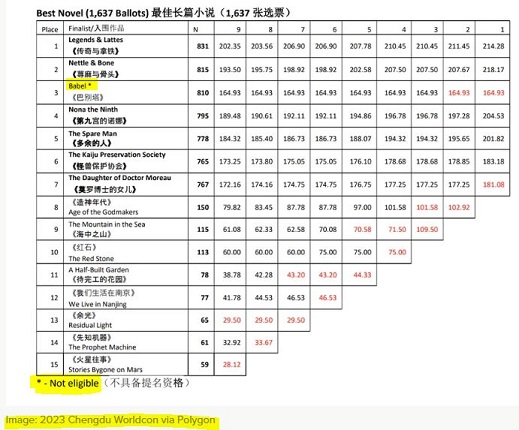
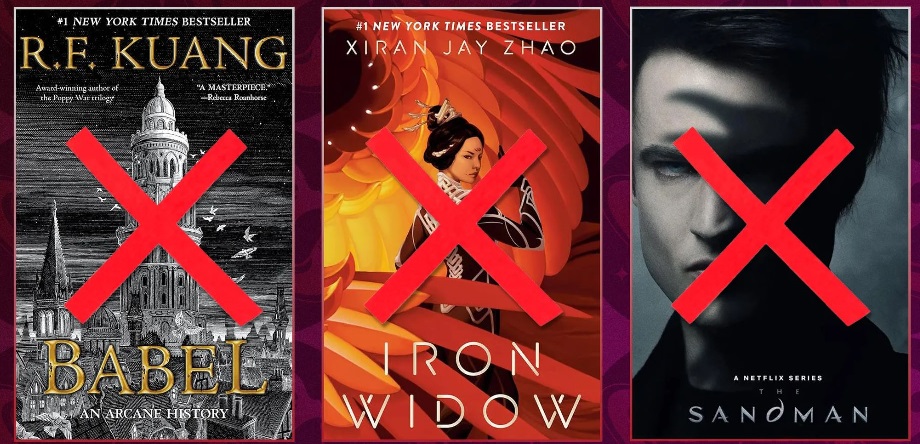
R.F Kuang’s Babel, a fantasy-laden altenate history of the Opium Wars (fought by Britain and China from 1839 to 1842) was disqualified despite having earned so many votes that it still came in third place for Best Novel despite the inelligibility. The story is a complicated history, painting fictional British and Chinese characters alike in shades of gray. I both reviewed and reflected on this book. I loved it. It’s not hurting for recognition – it won the 2023 Nebula for best novel… but this makes the removal all the more suspicious. R.F. Kuang is a Chinese-American author.
Xiran Jay Zhao was disquialified for the Best New Writer award, after being a finalist the year before (writers are elligible for two years after they publish their debut novel). They are an outspoken activist whose very popular YA novel Iron Widow features many LGBTQ+ characters and draws parallels from China’s history. Her TikTok post about the removal was removed from the platform, to noone’s surprise, given that TikTok is owned by ByteDance, which is based in China. Zhao is a Chinese-Canadian author.
The Sandman episode “The Sound of Her Wings,” based on the graphic novel by Neil Gaiman, was disqualified from Best Short-Form Dramatic Presentation. This one is the most difficult to parse. The episode features a black woman as the personification of death, discusses suicide, features a holocaust survivor. It has nothing to do with China, and, says nothing about current human-rights events, and, to my memory, if it has LGBTQ+ characters, they are not prominent. Personally, I literally cried watching this episode. I cannot imagine what triggered the censorship. Maybe the local committee thought the vibes were off.
Disqualified Authors Respond
I’ll let the disqualified authors speak for themselves:
R.F. Kuang released a statement on Twitter: “Until one is provided that explains why the book was eligible for the Nebula and Locus awards, which it won, and not the Hugos, I assume this was a matter of undesirability rather than ineligibility. Excluding ‘undesirable’ work is not only embarrassing for all involved parties, but renders the entire process and organization illegitimate. Pity.”
From Zhao: “I can only guess to why I was excluded, but it probably has something to do with my critical comments about the Chinese government in the past,” said Zhao. “You would think that as a big, powerful country, China would be graceful about criticisms, but they in fact take it very personally, and doubly so when it’s from Chinese diaspora.”
From Gaiman: “Until now, one of the things that’s always been refreshing about the Hugos has been the transparency and clarity of the process … This is obfuscatory, and without some clarity it means that whatever has gone wrong here is unfixable, or may be unfixable in ways that don’t damage the respect the Hugos have earned over the last 70 years.”
So Now What?
Honestly, the milk has spilled, the spillers are silent and geographically removed from the fallout, and the awards were handed out three months ago. The die was cast. There isn’t a big actionable take-away here other than to say… boo. Badly done, Hugos. Badly done, indeed.
That’s it for book news. Come back next week for more book reviews, folks.

Bonus: We’ve reviewed this year’s finalists
Controversy aside, I’ve reviewed (or will soon review) many of this year’s finalists in this space. Who knows how the inclusion of the disqualified books might have affected the outcome, but here they be, for what it’s worth:
- Nettle & Bone, by T. Kingfisher (Tor Books) -> Coming soon!
- The Daughter of Doctor Moreau, by Silvia Moreno-Garcia (Del Rey)
- The Kaiju Preservation Society, by John Scalzi (Tor Books)
- Legends & Lattes, by Travis Baldree (Tor Books)
- Nona the Ninth, by Tamsyn Muir (Tordotcom)
- The Spare Man, by Mary Robinette Kowal (Tor Books)
Sources:
“Hugo Awards Under Fire Over Censorship Accusations, and SFF Writers Want Answers” by Sadie Gennis and Susana Polo for Polygon, Jan 24, 2024. Accessed Feb 6, 2024. <https://www.polygon.com/24049021/hugo-awards-controversy-china-censorship-babel>
2023 Jugy and Related Award Stats by 2023 Chengdu Worldcon. Accessed Feb 6, 2024. <chrome-extension://efaidnbmnnnibpcajpcglclefindmkaj/https://www.thehugoawards.org/wp-content/uploads/2024/01/2023-Hugo-Award-Stats-Final.pdf>
“Science Fiction Awards Held In China Under Fire for Excluding Authors” by Amy Hawkins for The Guardian, Jan 24, 2024. Accessed Feb 6, 2024. <https://www.theguardian.com/books/2024/jan/24/science-fiction-awards-held-in-china-under-fire-for-excluding-authors>
2023 Hugo Awards by The Hugo Awards, accessed Feb 6, 2024. <https://www.thehugoawards.org/hugo-history/2023-hugo-awards/>
2023 Hugo Nomination Report had Unexplained Ineligibility Rulings by Mike Glyer for File770, Jan. 20, 2024. Accessed Feb 6, 2024. <https://file770.com/2023-hugo-nomination-report-has-unexplained-ineligibility-rulings-also-reveals-who-declined/>
 JC Murray Books