

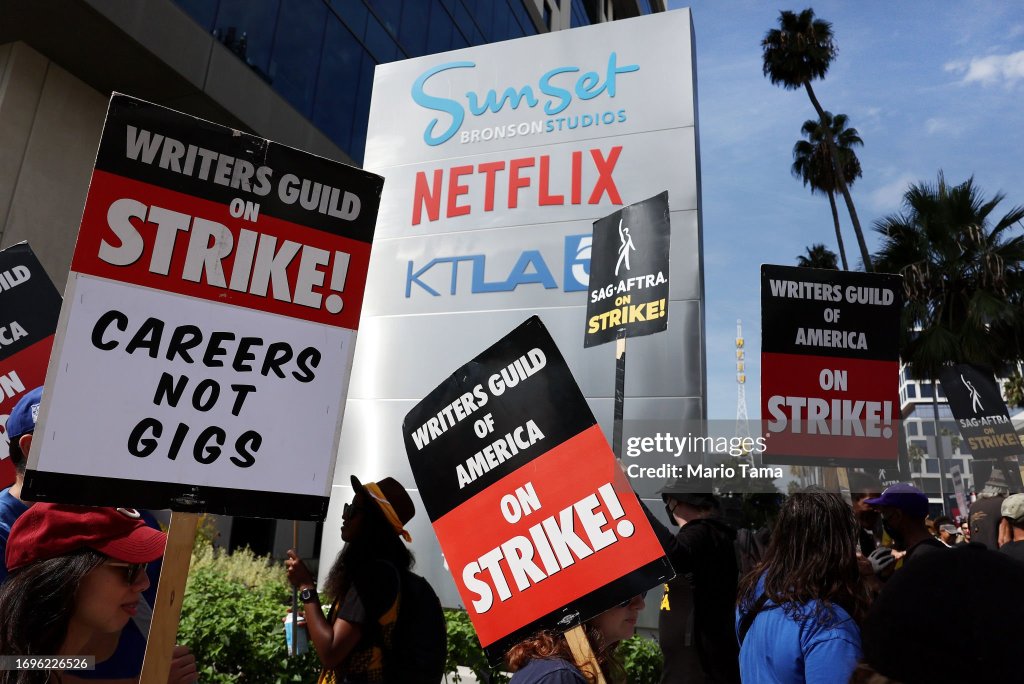
On September 27th, after 148 days on the picket lines, the Writer’s Guild of America struck a deal with the major entertainment studios.
It’s been a couple of weeks. The dust has settled and the deal is ratified. The Actors are still on strike, but work will soon resume on your favorite shows. I wrote toward the beginning of the strike about what the union was fighting for. It’s only fitting that I update you on what the screenwriters won. The top-line summary, is that the union initially demanded changes which would result in an estimated additonal $429 million/year, studios countered with a $86 million/year deal, and ultimately agreed to a contract worth $233 million/year.
The items below are just some highlights. If you’re interested, check out the full deal or the summary over at the WGA itself.
More Money Across the Board:
- Minimum residual payments between 3.5 and 5%, depending on many factors.
- Weekly rate raise for staff writers.
- Any streaming property with a budget of $30 million or more is treated like a full theatrical release movie for contract/pay calculations, resulting in a retroactive 18% and a forward-looking 26% increase in residual pay.
- Required increased pay for proposed work once accepted (this helps with, but does not remove, the problem where writers were required to write an entire season without pay, before knowing if it will be accepted. Work-without-guarantee has always been true of novelists, but traditionally a pilot and a season outline have been enough in hollywood prior to the streaming era).
- Established a new payment tier for more experienced writers, called a “writer-producer”, including rules for when a show must employ a writer-producer based on how long the show runs each year and how many writers they hire.
- Established industry standard bonuses for viewership of straight-to-streaming movies. If at least 20% of a streaming platform’s subscribers view a movie, everyone gets paid.
- Writers get paid residuals for shows viewed on ad-supported streaming services.
More Favorable Rules Around Employment and Pay Elligibility:
- Streaming data transparency required. No more short-changing emplpyees by hiding subscrber and viewership data.
- Minimum payroll guarantees of 10 – 20 weeks depending on the type of show.
- Faster and firmer payment schedules for flat-rate commission work.
- Broadened the definition of which shows require a weekly salary, which means longer employment periods and higher pay for more unscripted television and streaming shows. (budget requirements apply).
- Required re-negotiation when a show moves to streaming for the first time.
- Established a standard basis for counting subscribers based on the country with the largest number of subscribers. (You know there’s a story here. Some writer somewhere must have been screwed big time when a studio counted their subscribers in the US Virgin Islands or some similar ridiculous standard).
On Artificial Intelligence:
- Established that artificial intelligence does not count as a “writer” for any purpose above. This important, because it prevents studios from using them to fulfill requirements for hiring certain numbers of writers or having writers in certain roles.
- Writers commit to not using AI.
- Companies must disclose if they use AI.
- Guild might sue over using writing material to train AI. This is interesting, because it’s not a promise or a ban, just a looming future threat. I would not be surprised to see a legal battle over AI training in the next few years.
The Future of AudioVisual Entertainment?
On last week’s Plain English podcast with Atlantic writer Derek Thompson, a guest clarified that something like 30 – 40% of people under 25 prefer shortform videos (TikTok, Youtube Shorts, Facebook Reels, etc) to any other form of entertainment. How does a company making multi-million-dollar episodes of scripted television released months after they were created compete with that?
In this increasingly saturated ecosystem, the value of any individual property is going to steadily decrease. That’s 9th grade economics; supply is far beyond our capacity to demand. In the face of that, studios and streamers had been whittling away at writers’ earnings for years. I am glad for the protections and guarantees the writers have earned, even though I know it will ultimately mean less options and higher prices for consumers. It will also mean that although the successful writers are paid better, the barrier to entry will be higher. I expect fewer writers hired per show, and that many studios will try to limbo under the time/staff/budget/etc minimum requirements laid out in this deal, especially on ‘risky’ or new shows.
The 7.99-for-everything-on-one-platform era is over. It was an illusion, conjured by a macigian called Netflix who only cared about capturing market share, enabled by slow-moving studios who were more than happy to license their old content cheaply. The honest truth is I don’t need every option under the sun. Nobody does. Here’s hoping for fewer, higher-quality shows in the future I can feel good about watching, knowing the creators behind them are fairly compensated for their work.
Get Murray’s Bookshelf in your inbox whenever there’s an update.
Connect with us: Facebook: MurraysBookshelf

